WaterCalcLab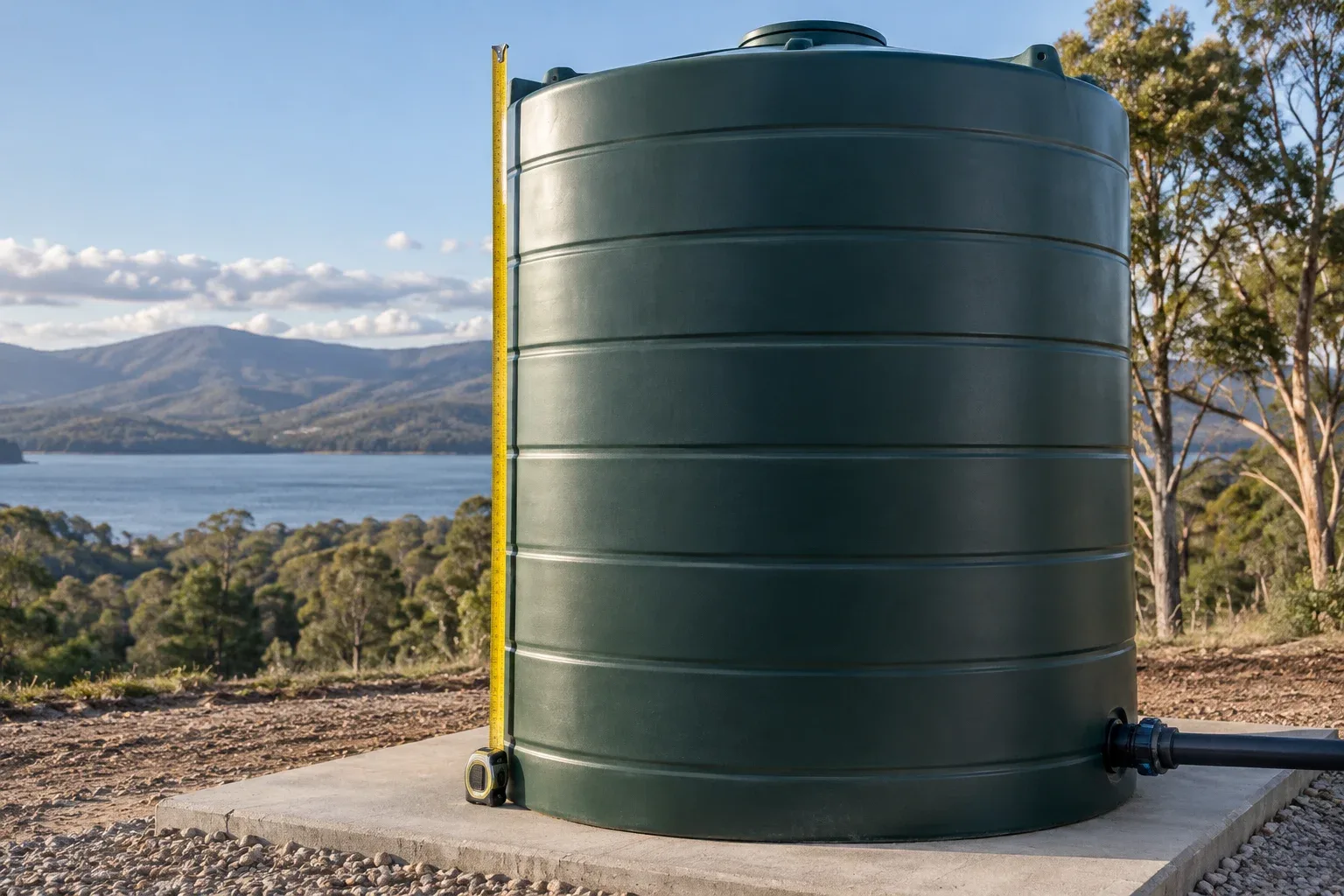
Geometry and sizing answer different questions
Geometry tells you the volume inside a shape. Sizing asks whether that volume matches supply and demand. Establish which question you need to solve. A correctly calculated cylinder volume can still be an unsuitable garden supply. Conversely, an appropriate capacity target needs product dimensions and operating levels to confirm how much water can actually be stored.
Measure internal dimensions
For a rectangular tank, multiply internal length, width and water depth. For a vertical circular cylinder, use π × radius squared × water depth. All dimensions must use the same length unit. External dimensions overstate internal volume when wall thickness or fittings occupy space. An irregular container needs a manufacturer capacity chart or measured calibration rather than an invented simple shape.
Subtract the inaccessible bottom layer before assessing supply duration.
Vertical cylinder: 1.4 m internal diameter, 1.5 m water depth, 0.1 m inaccessible; rounded.
A cylinder example
A vertical tank with an internal diameter of 1.4 metres and an operating water depth of 1.5 metres has a volume of π × 0.7² × 1.5 = approximately 2.309 cubic metres, or 2,309 litres. If the inaccessible bottom layer is 0.1 metres deep, its volume is approximately 154 litres. Accessible volume is therefore about 2,155 litres for that configuration.
Calibrate a level indicator
In a vertical cylinder with constant cross-section, equal height increments represent equal volume increments. In a horizontal cylinder they do not. Do not label a half-height reading as half the full volume for arbitrary shapes. Confirm the calculator’s supported orientation and use an appropriate level-to-volume chart where the tank profile changes with height.
Then test adequacy over time
For a preliminary dry-spell assessment, divide usable capacity by chosen daily demand. For realistic sizing, simulate rainfall inflows, withdrawals, tank limits and overflow over several periods. An annual balance alone cannot identify empty weeks or quantify how extra capacity changes reliability. Keep the geometric measurement and the demand assumptions separate in project records.
Capacity checklist
- Use internal dimensions.
- Distinguish radius from diameter.
- Convert units before multiplication.
- State tank shape and orientation.
- Use actual operating depth.
- Subtract unavailable volume.
- Round to justified measurement precision.
- Assess seasonal supply separately from geometric volume.