 WaterCalcLab
Annual Water Savings Calculator
Calculate annual replacement potential for a specified number of active days. Enter annual usable supply.
Your result
Bars compare only results in the same unit group. They are normalized, not a time-series forecast.
Planning result based on your inputs.
How this tool works
Calculate annual replacement potential for a specified number of active days. Enter annual usable supply.
annual demand = daily use × active days; savings = min(supply, demand)Example calculation
The prefilled form is a worked example. Its base-unit inputs and expected outputs are shown below; use the reset button to restore it.
| Input | Example |
|---|---|
| Daily demand | 100 |
| Days | 21 |
| Available supply in the same period | 15000 |
Planning notes for this calculator
Estimate annual mains replacement for a use active on a specified number of days. This distinguishes seasonal gardening from a use that occurs every day of the year.
Choose meaningful inputs
- Daily demand
- Enter daily eligible use on active days, not an already annualized total.
- Days
- Count days when this use occurs during one year, up to 366. Seasonal uses can be much lower than 365.
- Available supply in the same period
- Use annual usable rainwater supply on the same annual basis as the demand.
Read the result correctly
Annual eligible demand equals active-day use multiplied by active days. Replacement is the smaller of that demand and annual supply. This is a volume ceiling, not a daily storage simulation. Rain outside the use season can overflow before the season starts, so annual supply alone may overstate the amount that can replace mains water.
Common mistakes to avoid
- Do not enter a weekly consumption figure as daily use without conversion.
- Active days describe use, not the number of rainy days.
A useful next step
Build a month-by-month or daily comparison of supply, use and tank space before estimating financial savings.
Follow a worked scenario
A separate illustrative scenario; these values do not change when you edit the form above.
- 100 L per active day × 180 active days = 18,000 L annual eligible demand.
- With 15,000 L annual usable supply, potential replacement is limited to 15,000 L.
Frequently asked questions
Should I always enter 365 days?
Only for a use occurring every day in a non-leap year. Seasonal watering and intermittent uses need their actual number of active days, with a matching annual supply estimate.
Can actual savings be below the smaller annual total?
Yes. Storage capacity and timing can prevent rainwater reaching the intended use. Measured withdrawals replacing mains water are stronger evidence than this annual upper bound.
Continue your plan
Rainwater Savings Calculator
Bound potential mains replacement by both available rainwater and eligible demand in the same period.
Open calculator ↗Costs & savingsWater Cost Calculator
Calculate a single volumetric tariff plus a fixed charge in the same billing period.
Open calculator ↗Costs & savingsRainwater ROI Calculator
Estimate simple annual payback using eligible annual demand and actually available annual supply.
Open calculator ↗Related reading
 Costs & savings
Rainwater System Payback Period
Simple payback divides initial investment by annual net cash savings. Net means avoided consumption charges minus relevant recurring costs. Gross roof collection is not an annual cash saving. Estimate water that actually replaces billed use, check the applicable tariff and keep assumptions dated. The calculation is a planning scenario, not a guaranteed investment return.
Read guide ↗ Costs & savings
Understanding Water Costs
Find billed volume, billing period, volume units, fixed charges and the consumption-dependent tariff. Check whether water and wastewater appear separately. Utilities can use cubic metres, gallons or other billing units. Convert the volume first, then calculate cost. A bill total divided by volume may be an average paid rate, but it is not necessarily the rate avoided by using one less unit.
Read guide ↗ Costs & savings
How to Calculate Water Savings
Decide whether savings mean less utility water, less total water used or lower expenditure. Rainwater substitution can reduce utility demand without reducing total garden use. More efficient irrigation may reduce both. Keep these measures separate so one benefit is not counted twice. Describe the baseline and the proposed change before presenting a percentage.
Read guide ↗ Garden irrigation
How to Reduce Garden Water Consumption
Record watering events, measured flow and runtime by zone. Note rainfall, weather and plant condition. A bill for the whole house mixes garden use with other consumption, so a submeter or event log can be useful. Establish which zones consume most before buying hardware; a small low-use bed offers less volume-saving opportunity than a poorly controlled large zone.
Read guide ↗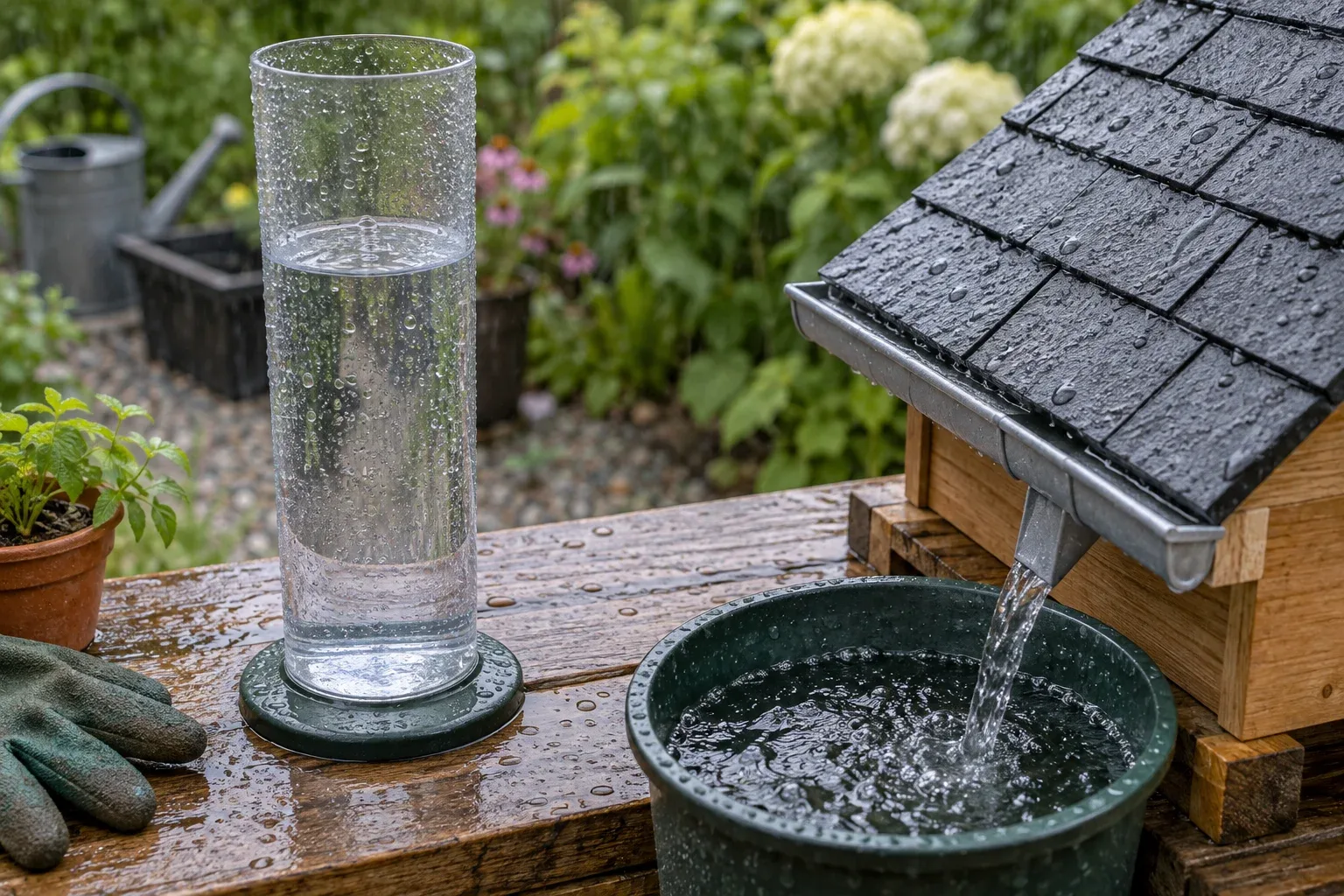 Rainwater harvesting
How Much Rainwater Can You Collect?
Specify whether you want the potential from one storm, one month or one year. Each question needs rainfall covering that same period. An annual total is useful for screening a project, but it cannot tell you whether a tank is full during a particular dry week. Keep the rainfall source, location, period and measurement unit with the result.
Read guide ↗ Costs & savings
Water Conservation at Home
List regular activities and any fixtures or equipment involved. Record occupancy and separate indoor use from irrigation where possible. Meter readings reveal the whole-home total; event measurements explain where it goes. Focus first on avoidable use that can be changed without compromising necessary hygiene, health or the performance of essential equipment.
Read guide ↗Sources & method references
- Texas Water Development Board: Rainwater Harvesting Manual
Collection, storage and system-planning context. Geometry and unit conversions on this page are stated explicitly.
- US EPA WaterSense: Understanding your water bill
Volume units and billing structures. Enter your own applicable supplier prices.
Method version 1.1 · Explanations and examples reviewed: 2026-10-11